Wednesday, 26 January 2011
Hand in - Goodbye CAD
Three down, Three to go!!
AD202 Digital Applications (10 Credits) Hand in date - 25th January 4pm (REVISED HAND IN - 26TH JANUARY 9AM)

Monday, 24 January 2011

Thursday, 20 January 2011
Near Wild Heaven
AD205

I have chose this photo as it represents to me what my collection will be about. It's very feminine yet sexy and shows a natural and organic setting which is what I aim to create throughout my research and mood boards before looking at developing some designs from this theme.
Wednesday, 19 January 2011
The Proposal
AD205

Ok, so the thing I love about this project is that its really personal, its all about me!
The Final Major is a reflection on myself, being a self directed brief I have the ability to create my own 'format' to the module.
So my first idea for the proposal is to create a very girly/feminine collection that portrays my way of thinking when in comes to fashion, I plan to take inspiration from a variety of natural sources and especially music and film.
Aswel as taking into consideration trend and colour forecasting I will look at past collections from established and new talented/fresh designers.
In past projects, I have tried to stay away from repetitive themes and the feminine style I usually fall into and have previously attempted to explore and experiment with totally different types of fashion, but for my Final Major Project I think the best way to show my full potential is to develop on what I know I can be successful with; as this work will be a representation of me and could well shape my future as a designer.
Thursday, 13 January 2011
All That We Are

FINAL MAJOR PROJECT
The main aim of this module is to consolidate your understanding of the applications of fashion to enable you to design, develop and manufacture an innovative and individual garment or garments for a final collection through a self directed brief. By using your strengths, strive to be innovative, creative and embark on a personal voyage of discovery, style and design.
It is important as ’fashion students’ you observe what is going on around you, influences on the street e.g. London, New York, Tokyo etc and designer trends. Look particularly at the success of a fresh breed of talented young designers who have shown remarkable creativity and tenacity such as Todd Lynn, Preen, Zac Posen, Gareth Pugh, Jessica Ogden, Giles Deacon, Christopher Kane, House of Holland, Imitation of Christ etc. Also look at established designers and design houses that generate trends, reinvent and have a great influence in fashion.
Shop Report.
You must carry out a shop report in more than one city. Visit designer stores and boutiques to identify fashion and lifestyle trends. Target your research to a particular market level and record competitors within your chosen market level along with company ethos and design strengths, price points and use of fabrics, trims etc.
Proposal.
Write your own capsule collection proposal approx 200 words outlining your ideas. What is it you aim to achieve with this module? This proposal should also evidence market level and garment proposals and be made readily available for discussion with your tutors and industry, if applicable.
Research.
A strong foundation creates a collection with depth, integrity and personality. Begin by exploring your ideas and record findings with visual imagery, annotation and drawings and continue pushing the extremities of where this journey may take you. Be open to the unknown! You can look at books, magazines, exhibitions, media, films, video, photography websites etc as your starting point. This work must be evidenced in your A3 portfolio.
Fabric Sourcing File.
Create a fabric sourcing file. Explore which fabrics you will use for your garment or garment collection. Research supporting trimmings, hardware and all components need for your garment or garments recording the supplier and costs.
Portfolio
For your portfolio presentation, you must create a final capsule collection of several outfits. This range of work must be evidenced within your A3 portfolio. The work must contain an expansive range of development sketches demonstrating your thought process and decision making of realising your ideas. You must also evidence annotation within your development conveying your decision making process.
Garment(s)
You must then realise a garment or garments from your capsule collection. This work must be driven by your target market and demonstrate appropriate solutions to be realised to a standard required for your practice.
Evaluation.
You will evaluate your own learning, producing a written statement - 200 words, in relation to the realisation of your final garment, garments analysing the commercial viability and application of the work in relation to your target market.
Wednesday, 12 January 2011
Organizing is Fun and You Know it
Ok, lets re-cap...
Project 1 - AD201 Personal & Professional Development (12th May)
Project 2 - AD203 Art & Design Method (10th Nov)
Project 3 - AD202 Digital Applications (25th Jan)
Project 4 - AD208 Skills Development (16th Dec)
Project 5 - AD207 Work Based Project(21st May) Revised Hand in- (5TH MAY 9AM)
NEW PROJECT
FINAL MAJOR
Project 6 - (AD205)
AD205 Art & Design Application (20 Credits) Hand in date - Thursday 7th April 4pm
Project 1 - AD201 Personal & Professional Development (12th May)
Project 5 - AD207 Work Based Project
NEW PROJECT
FINAL MAJOR
Project 6 - (AD205)
AD205 Art & Design Application (20 Credits) Hand in date - Thursday 7th April 4pm
- Shop Report
- 200 Word Written Proposal
- Individual Research
- Fabric Sourcing File
- A3 Development Ideas
- Garment(s) Produced
- 200 Word Written Evaluation
Wednesday, 5 January 2011
New Year, Almost New Start
AD208
As part of AD208 I had to track the process of the garment I designed for Anh Mao and create a photographic file or sketchbook to document my work, I decided to use Adobe illustrator for this part of the project as I have refined my skills during AD202 Digital Applications, I felt confident to use the software.
I think it works well completed on illustrator, it looks more professional yet still shows personality as I achieved to create quite an artsy effect to each document whilst showing a more technical side to the development.
Below is my development documentation in which I prepared for Hand in today.




Monday, 3 January 2011
Happy New Year!
New year so a new start! I plan on getting stuck in to my work and putting 110% into everything I do.
Hand in for AD202 is coming up and I'm almost finished my portfolio presentation for this module...
Snapshots of this below,


Hand in for AD202 is coming up and I'm almost finished my portfolio presentation for this module...
Snapshots of this below,


Don't get me wrong, I loved having two weeks off but I am actually quiet looking forward to going back to college..I get bored REALLY easy.
Tuesday, 21 December 2010
4 Days Until Christmas
AD202
So I've been working on my CAD work for Gemma over the Christmas Holidays and heres what I've come up with so far...


So I've been working on my CAD work for Gemma over the Christmas Holidays and heres what I've come up with so far...

I scanned in some of the embellishment from the actual garment so I could get the right effect on the technical drawing, this made it easier for me to concentrate on the more structured part of the design.

CAD is not one of my strengths but I tried my best to portray gathering on the bodice as best as I could using shading and gradient tools on Adobe illustrator.
Thursday, 16 December 2010

Sunday, 12 December 2010
The BIBA Experience

Biba remains one of the most evocative names in British design history; it pioneered a new style, mixing the contemporary with Art Nouveau, Art Deco and the golden age of Hollywood, dressing itself in the richly luxuriant colours of a bygone time. This book showcases Biba clothing and much of the Biba memorabilia, merchandising and interior design, presenting an entire history of the company. "Biba: The Biba Experience" centres on commissioned photographs of one of the largest collections of Biba in the world, put together by Pari, who has accumulated around 500 pieces of Biba fashion items and ephemera covering the entire history of the company. Everything from dresses and trouser suits through original sketches and patterns to playing cards and soap powder is represented. Biba brought the cutting edge of couture to the masses. Brigitte Bardot, Yoko Ono and Princess Anne shopped there, whilst Sonny and Cher, Mick and Marianne, and David and Angie were regular visitors, but the store was never the exclusive preserve of the rich and famous: prices were kept deliberately low, and anyone who could tolerate the disdainful inefficiency of the staff was encouraged to soak up the glamour of a unique shopping experience. This lavishly illustrated and beautifully produced book is intended for those interested in the fashion and graphic design of the '60s and '70s, from a creative and historical standpoint, plus the huge number of people who remember Biba from the period with such affection.


 iba is frequently mentioned in the same giddy breath as mini-skirts, Mini cars, the Kings Road, the pill and various other London 'happenings' which shall forever define the 1960's as a decade that swung. It was, however, born of humble origins - garments were initially sold cheaply and to many, by mail order in newspapers. But by the early 1970's, Biba - a labour of love, a label, a lifestyle - had reached hitherto unknown heights of sophistication, innovation and retail experimentation, via its legendary Big Biba emporium on Kensington High Street (once hailed in the Sunday Times as 'the most beautiful store in the world'). Biba makes for a true rags to riches story, though one devoid of a happy ending for its creators... fashion can be a very cruel beast.
In terms of design, ideas and presentation, Biba was the brainchild of Warsaw-born (in 1936) Barbara Hulanicki, working in partnership with her husband Stephen Fitz-Simon. Long before her reign as fashion queen kicked off, Hulanicki had endured an unsettling upbringing. Her father - a Polish Olympic athlete and diplomat - was snatched from their home in Palestine in 1948, and assassinated.
She, her mother and and two sisters Beatrice and Biba then moved to the grey, post war London of 1948. Her aunt Sophie (a diamond-dripping eccentric, who spent three hours each day dolling herself up) whisked the family to her home - a suite at the Ritz Hotel. Then Sophie moved the family to Brighton - she holing up in a gin palace, the Metropole Hotel, and the others in a flat. As her boozy Aunt mixed with the glitterati, Hulanicki dreamt of Hollywood, boys, fashion, and developed a talent for drawing. Following boarding school, then art college, she would eventually become a much in-demand fashion illustrator. Having moved to London, her work was featured in publications like Homes and Gardens, The Times, Daily Express and Vogue, and she got to sketch the frocks at Givenchy and Balenciaga's couture shows in Paris.
 n 1961, Hulanicki married Fitz-Simon, and several years later he suggested she design a garment to sell by mail order. Biba's Postal Boutique was duly formed and her long evening skirts with draw-string waists sold moderately well in the Daily Express. Other garments followed, with varying degrees of success, until Felicity Green, Fashion Editor of the Daily Mirror, proposed Hulanicki's design something for a reader's offer. The resulting pink gingham dress sold through the paper for 25 shillings, and immediately netted £14,000-worth of orders. And so began Biba proper, despite the business still being run ramshackle-style from the couple's flat. The fashion-influential likes of Ready Steady Go presenter Cathy McGowan, the 'Queen of the Mods', became a huge Biba fan, typifying the sort of young, liberated woman to whom the label appealed. Next came the very first in a series of Biba shops - a near-derelict former chemist on Abingdon Road, Kensington. Here, Hulanicki artfully went against the plastic-fantastic 'youth' ethos of the decade - retaining all the dilapidated, faded character of the premises, and kitting out the interior with navy blue paint, old bronze lamps and an antique Dutch wardrobe. (Her instinctive knack for mixing the best o the past with the shock of the new would prevail through Biba's progression - some three decades before 'eclectic' became a tired aesthetic cliché.) For the first year of the shop's existence, there was not even a sign over the door - word of mouth making 'hard sell' irrelevant. In terms of the Biba palette, again, in high fashion terms, convention was flouted: Colours were often funeral-like - blackish browns, dark prunes, plus rust and blueberry hues. Hulanicki realised, as she wrote in From A to Biba, that they were the 'dull, sad Auntie colours I had despised in my young days. They looked better in England's grey light, almost vibrant against the grey buildings and pavements'. Of a particularly successful brown chalkstripe Biba smock she also noted: 'The morning my father left for the last time he was wearing a brown chalkstripe suit'.
Business boomed. The shop shop eventually became too small for the hordes of customers - who often included celebrities such as fashion editor Molly Parkin, popstrels Sonny and Cher, actress Julie Christie and model Twiggy among their ranks. Hulanicki observed: 'All classes mingled under the creaking roof [of the shop]. There was no social distinction. Their common denominator was youth and rebellion against the establishment.' America lapped up this pulpable buzz, and the UK rag trade began to take note, too. In 1965 a new space was found - a former grocery on Kensington High Street. Again, a radical interior was created: Art Nouveau squiggles, painted in gold by fabric designer Tony Little, marked a new Biba store front sign; inside was lined with specially printed deep red wallpaper; the original grocer's mahogany shelves and counters were retained. Again, the shop was a thundering success - customers would queue and jostle before it had even opened each day, and could expect to see the likes of Yoko Ono, Brigitte Bardot, Mia Farrow or Barbara Streisand trying on togs alongside them.
Restless to expand their business, Hulanicki and Fitz-Simon found a much larger vacant building on Kensington High Street in 1969 - formerly a carpet warehouse. Initially, it seemed they had bitten off more than they could chew, (despite at the time making around £10,000 per week) and extra finances were needed urgently. Their bank and Dorothy Perkins provided extra investment, for a large stake in the company, and the project got the go ahead. The building's non-lovely fixtures were stripped back to the original Egyptian-topped columns and marbled floors; stained glass and wood panelling was appropriated from a nearby school being demolished; clothes were draped over old hatstands, lit by fringed lampshades; a heavily cushioned area below the stairs would play host to stoned hippies and the occasional tramp. Biba was no longer just about glad rags for girly gadabouts, either. In addition to the new cosmetics range (which would in its own right become de rigeur around the world) plus shoes and boots, there were now household products (everything from Biba wallpaper to Biba baked beans and Biba soapflakes), and mens/childrenswear was also on offer. The finished result was more glamorous, more decadent, than any other store in the city. On its opening day in 1969 - as the loudest, latest sounds pumped from the stereo - the Daily Mail counted 30,000 customers scurrying across the threshold. The store grew in popularity, not to mention notoriety: some of the female staff forming trade unions to protest at perceived unfair working conditions, and anarchist group the Angry Brigade blowing up a bomb there - to protest at women being enslaved to fashion.
 et Hulanicki felt that Biba could become an even bigger phenomena still. She obsessed over the 400,000 square foot, Art Deco Derry and Tom's department store on Kensington High Street. It had long since faded from glory, but was still complete with its romantic rooftop garden (today, this is still in existence and utilised for dining, private parties and promotional events, such as album launches). Following many complex financial twists, turns and near misses, and with the involvement of the Fraser group and Dorothy Perkins, they secured the building for £3.9 million. Literally hundreds of builders duly prepared the space - working to a budget of £1 million - and toiling around the clock for months on end. The former Biba store can, in hindsight, be seen as a dress rehearsal for this ultra-bold venture: Big Biba - the first new department store in the Capital since the second world war. Though it was not so much a mere department store as a kind of spectacular fantasy-land shopping/eating/drinking/hanging out/rooftop garden-perching experience. One entire floor was named the Casbah - filled with Moroccan and Turkish-influenced splendour; there was a Biba food hall; anyone could sit in the windows - traditional displays were banished (which would be deemed commercial suicide in this day and age); penguins and pink flamingos lived on the roof; the Rainbow Room restaurant and concert hall - with its pink marbled floors - served 1,500 meals a day on exquisite black china. Performers whom appeared there ranged from the New York Dolls to The Wombles, from Liberace to The Bay City Rollers, with artist Andrew Logan hosting oppulent fancy dress parties, still talked about to this day.
Alas, the dream could not last. Biba's business partners sold out their large stakes in the company to the British Land organisation, who totally failed to appreciate the intuitive and lucrative methods employed by the twosome. Gradually they were eased out - ultimately over-ruled and derided by the men in suits. Tacky mannequins, cheap signs and harsh fluorescent lighting replaced the lush, dark 1930's ambience of the store, and heralded the end of its glory days. It had become scruffy and sad. Their spirit broken, Hulanicki and Fitz-Simon quit on 1975, and moved to Brazil. The store closed down shortly afterwards. Following the death of her husband, Hulanicki - now based in the Art Deco heaven of Miami - has since carved out a new career, renovating the prestigious South Beach hotels like The Marlin.
So, as hippy-esque chic once again ventures to fashion's front-line, and the new London boutiques are springing up - such as Concrete and b - which fuse 'old-fashioned' elements (antique fixtures, pieces of vintage clothing), alongside upfront garb from the most influential young designers, it is easy to spot the legacy of Biba living on. But what is it, specifically, about the label that captures people's hearts? Nostalgia plays a part, obviously. Hulanicki believes: 'It became a meeting place. Years later I had letters from people who met at Biba, spent their courtship in Biba on Saturdays, married, had babies and wrapped them in Biba purple nappies.' But for those not old enough to remember the Biba experience first hand, it also holds an enduring fascination for its ambition, its accessibility, the impossible grandeur of the Big Biba store and so on. Berlin-born Pari is a London-based collector, who now owns the largest collection of original Biba clothing and merchandise. She explains: "When I first started collecting Biba, I began to advertise and people would call me up - not just wanting to sell, but just wanting to talk about it, to tell me stories about the store. It was a whole lifestyle to people then. And you have to remember that, price-wise, Biba meant that you could buy a whole outfit and accessories for the same prices as on Mary Quant garment. Before Biba, fashion was all very haute couture - it changed all that." Pari is determined to sell her entire collection en masse to a museum rather than see it split up, and has recently launched her own website which documents the myriad items she owns, along with an archive of press coverage.
Thursday, 9 December 2010
Extended Deadline - Due to Heavy Snow Fall
AD208
Finishing Touches

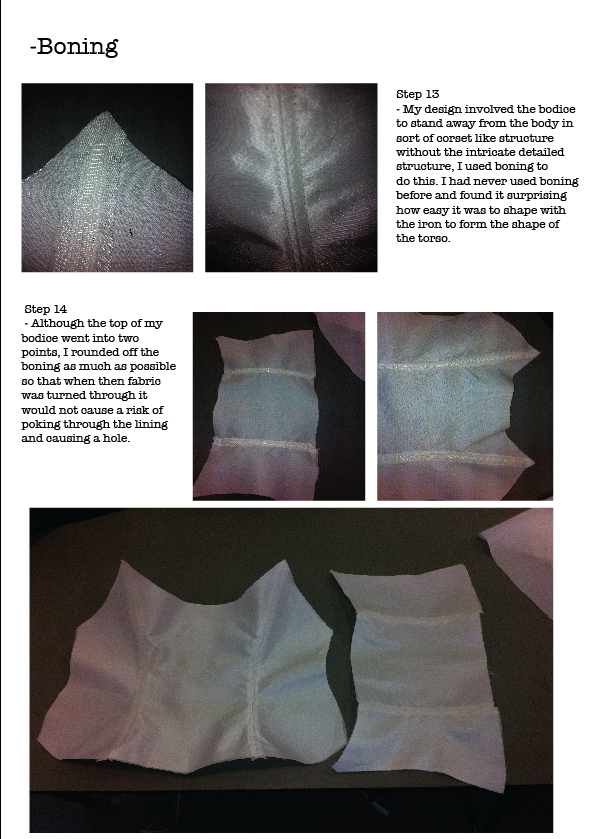
Firstly I had to sew the lining in right sides together.

Once the lining was in place, due to the nature of the design structure and the pointed edges I had to trim the seam edge as close as possible in the fiddly places to ease the turn through.

This is the bodice turned through, I then went on to create a top stitch which held the lining in place and stopped the bodice edge rolling over.
Wednesday, 8 December 2010
Snow is Falling
AD208
Trimming

Once all of the embellishment was in place, I could then see a definite hem line appearing I then cut off the excess fabric ready to create a finished pin hem.

This is what the skirt looked like after I created the asymmetric hem line.

Before attaching the skirt to the bodice I pinned it on the mannequin to see what it looked like all together.
Thursday, 2 December 2010
No Strings Attatched
AD208

After the gathers were sewn in place I attached the side seams.

Above is a close up of the gathers.

I wanted to see the developments on the mannequin so I could view it properly, and see any changes that needed to be made.

Wednesday, 1 December 2010
Wish Upon a Star
AD208
Embellishment

The process of embellishment was very long and tedious but definitely worth while, I am very happy with the result.

I slowly started to build up the embellishment on the skirt creating an asymmetric hem line.

I did play with the idea of having the embellishment all one size but after experimenting with scale I realised not only does it look better overall and more interesting but would be less time consuming to produce.
Subscribe to:
Posts (Atom)